
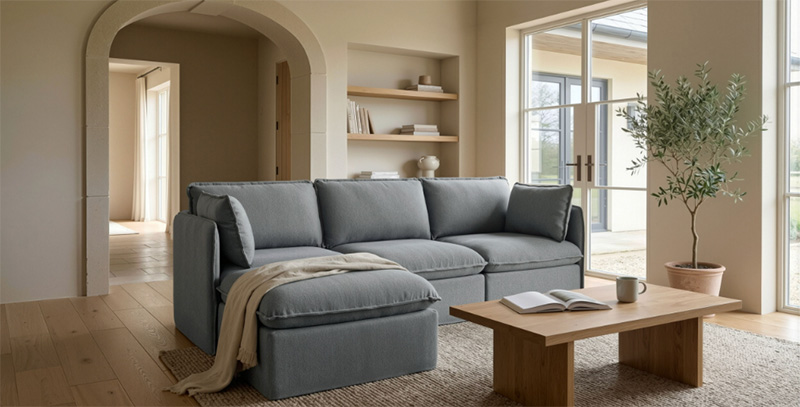
Knowing the typical dimensions of a couch prevents you from ending up with furniture that’s too big or small. (There’s nothing worse than falling in love with a couch only to find it won’t fit through your doorway or completely take over your living room.)
As modular furniture gains popularity, brands like Diorama and Anabei are transforming how shoppers think about sofa sizing, with adaptable systems that fit different spaces and lifestyles. This guide breaks down standard couch dimensions and explains how to choose the right size for your room.
What Is Standard Couch Size?
Length depends on how many people are seated. A standard couch size for a three-seater typically measures 72 to 96 inches long. Two-seater loveseats measure 48 to 72 inches long. Four-seater sofas go beyond 96 inches.
Comfort is all about depth. A typical couch depth is 32 to 40 inches from front to back. The deeper the couch, the more room you'll have to relax; the shallower the couch, the better it will fit in a tight room.
Height includes back and seat. Typical couch sizes include overall heights of 30 to 36 inches. This affects how easy it is to sit down and get up.
Standard Couch Sizes by Type
Loveseat Dimensions
Length: 48 to 72 inches Depth: 32 to 38 inches Height: 30 to 36 inches Seating: 2 people comfortably
West Elm's loveseats start around 60 inches long with comfortable cushions and quality upholstery. Also, with the compact size - it works perfectly in small apartments or home offices.
Standard Three-Seater Sofa
Length: 72 to 119 inches Depth: 25 to 32 inches Height: 25 to 36 inches Seating: 3 people comfortably
Many modular three-seater sofas, including options from Diorama, fall within this range while offering the flexibility to expand into larger sectionals over time.
Sectional Couches
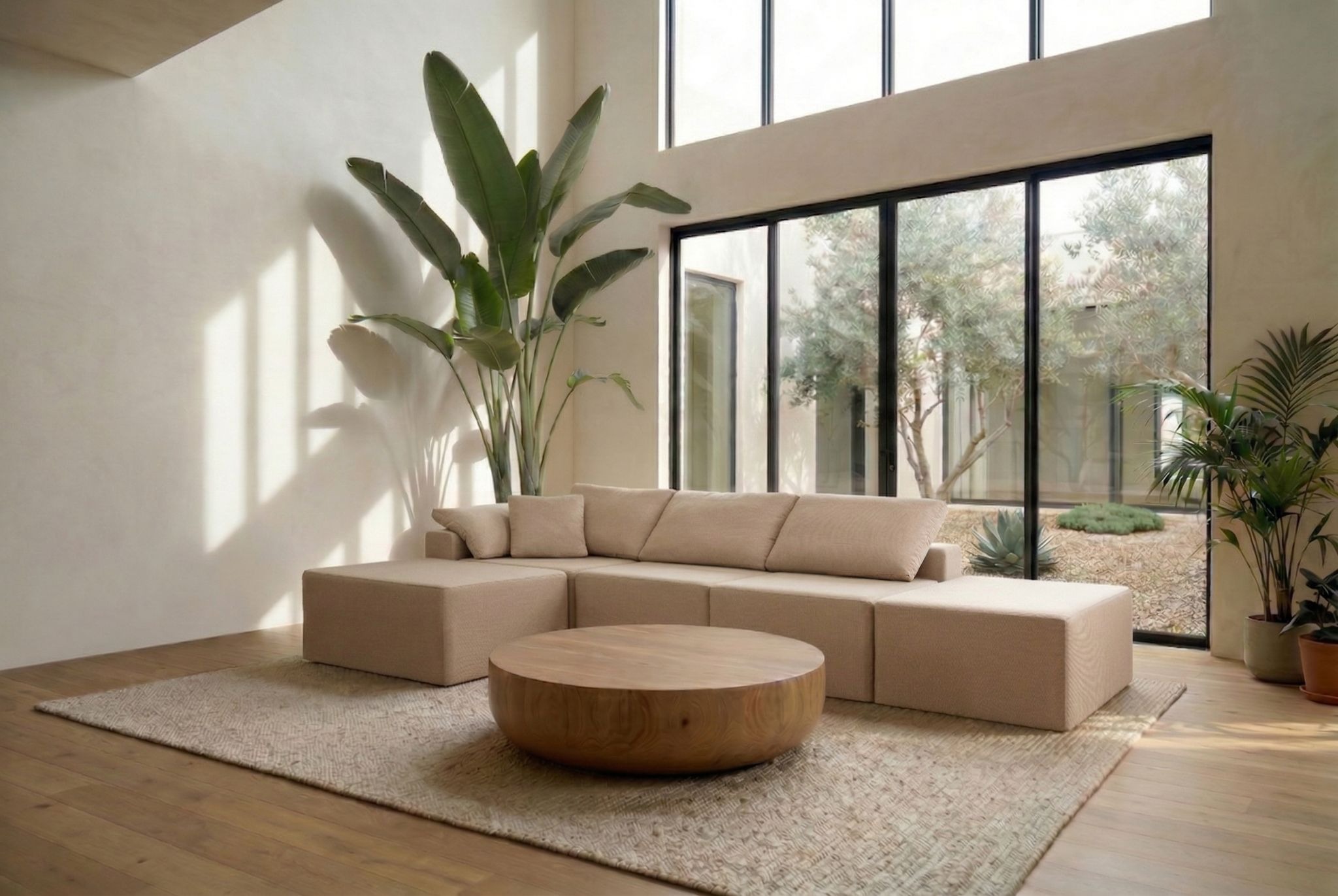
L-shaped sectionals: 95 to 120+ inches on the long side U-shaped sectionals: 120 to 150+ inches across Depth: 35 to 40+ inches Seating: 4 to 8+ people
Modular brands like Diorama and Anabei have helped popularize this category by allowing homeowners to build sectionals around their space rather than forcing rooms to accommodate fixed furniture dimensions.
Average Dimensions of a Couch by Room Size
Choosing couch dimensions that fit your space ensures a balanced layout, keeping rooms feeling open and well-proportioned.
Small Rooms (Under 150 Square Feet)
Best standard couch size: Loveseat or compact three-seater Typical dimensions: 60 to 78 inches long
Smaller couches leave enough walking space and keep rooms from feeling stuffed. Anabei’s compact sofas work perfectly while still giving you quality comfort.
Medium Rooms (150 to 250 Square Feet)
Best standard couch size: Standard three-seater or small sectional Typical dimensions: 78 to 96 inches long
Medium-sized couches balance seating with enough space to move around. Sabai's standard sofas at about 84 inches fit medium rooms perfectly.
Large Rooms (Over 250 Square Feet)
Best standard couch size: Large sectional Typical dimensions: 96+ inches or sectionals spanning 120+ inches
Larger furniture helps properly ground spacious rooms so they don’t feel empty or under-furnished.
Typical Couch Sizes for Different Lifestyles
Singles and Couples
Best size: Loveseat or compact three-seater (60 to 84 inches)
Two people don't need huge seating for everyday use. West Elm's loveseats give plenty of seating while keeping comfortable cushions.
Small Families (3-4 People)
Best size: Standard three-seater or L-shaped sectional (84 to 110 inches)
Families need enough seating without making entire rooms just about the couch. Sabai’s modular approach makes it easy for families to start with a smaller setup and add more sections over time as their needs change and kids grow.
Large Families (5+ People)
Best size: Large sectional (120+ inches)
For larger households, expandable modular systems from brands like Anabei provide the flexibility to add seating over time without replacing an entire sofa. This approach can be especially useful for growing families or homes that frequently entertain guests.





How to Measure for Standard Couch Size
Record the length, width, and height of your space to understand exactly how much room is available for your sofa and other furniture.
Check doorways and hallways. Measure all entry points the couch passes through during delivery. (Many typical couch sizes won't fit through narrow doorways without taking off legs.)
Leave walking space. Keep at least 30 to 36 inches of clearance around the couch. The average dimensions of a couch work only if enough space remains for walking.
Consider other furniture. Account for coffee tables, side tables, and other pieces sharing the space.
Use painter's tape. Mark the couch footprint on your floor to see how much space it really takes. Walk around it to test if it feels right.
Plan for future moves. Consider whether your sofa will fit potential future spaces, especially if you might relocate, to ensure it remains practical long-term.
Why Modular Sofas Outperform Fixed Sizes
Traditional fixed-size couches limit flexibility, while modular systems from brands like Diorama and Anabei allow homeowners to customize layouts around their space, lifestyle, and future needs.
Fits your actual space. Rather than settling for predetermined typical couch sizes, modular pieces allow you to configure your sofa to the size you need.
Grows with your needs. Start small and add pieces over time as budgets or living situations change. Your sofa can expand without replacing the entire set.
Works in new spaces. Moving? Rearrange the same pieces to fit new dimensions rather than buying completely new furniture.
Deep comfort no matter the size. When selecting a loveseat or a large sectional, top brands maintain consistent depth and comfort.
Easy maintenance at every size. Many modular sofas feature removable covers, making cleaning simple no matter which standard couch size you pick.
Budget-friendly growth. Modular pricing makes quality furniture possible. The approach allows slow expansion rather than large upfront costs.
Common Mistakes to Avoid
Choosing based on looks alone. A couch that looks perfect online might overwhelm your space. Always measure your room first.
Forgetting doorways during delivery. Standard sofa sizes don’t always fit through doorways or hallways. Check clearances before delivery and look for brands that have modular seating for compact packaging.
Ignoring depth for length. A couch might fit lengthwise but stick too far into the room, blocking traffic. Depth matters just as much as length.
Not considering the room's layout. The right sofa size depends on the shape of the room, not just its square footage.
Buying too big. Think ahead about future moves. A sofa that fits today will be too big for new spaces.
Making the Right Size Choice
For small apartments: Compact loveseats or three-seaters at 60 to 78 inches give enough seating without overwhelming the space.
For growing families: Flexible three-seaters that convert to sectionals adapt to changing needs.
For large homes: Large modular sectionals over 110 inches fill the room and provide deep, comfortable seating.
Budget friendly: Start with smaller setups and build up slowly with modular chairs to spread out costs over time without sacrificing quality.
Modular systems from brands like Diorama and Anabei make it easy to adjust your sofa to fit your space without giving up comfort or function. Whether you’re working with a small apartment and a loveseat or building out a larger sectional for a growing family, knowing standard couch sizes helps you put together a setup that feels balanced, cozy, and actually works for the way you live day to day.
FAQs
1. What are the standard couch sizes for living rooms?
Sofa dimensions vary by style, but most standard sofas measure between 72 and 96 inches wide with depths ranging from 32 to 40 inches.
2. What couch size works best for small rooms or apartments?
For small spaces, choose a loveseat (60–72 inches) or a compact sofa under 80 inches. These save space while still offering comfortable seating.
3. How do I choose the right couch size for large rooms?
Large rooms work well with full-size sofas, sectionals, or modular couches. Aim for pieces 90 inches or wider to balance the space and avoid a sparse look.
4. How much space should I leave around the couch?
Leave 30–36 inches for walkways and at least 12–18 inches between the couch and coffee table. This ensures comfort, flow, and easy movement.


